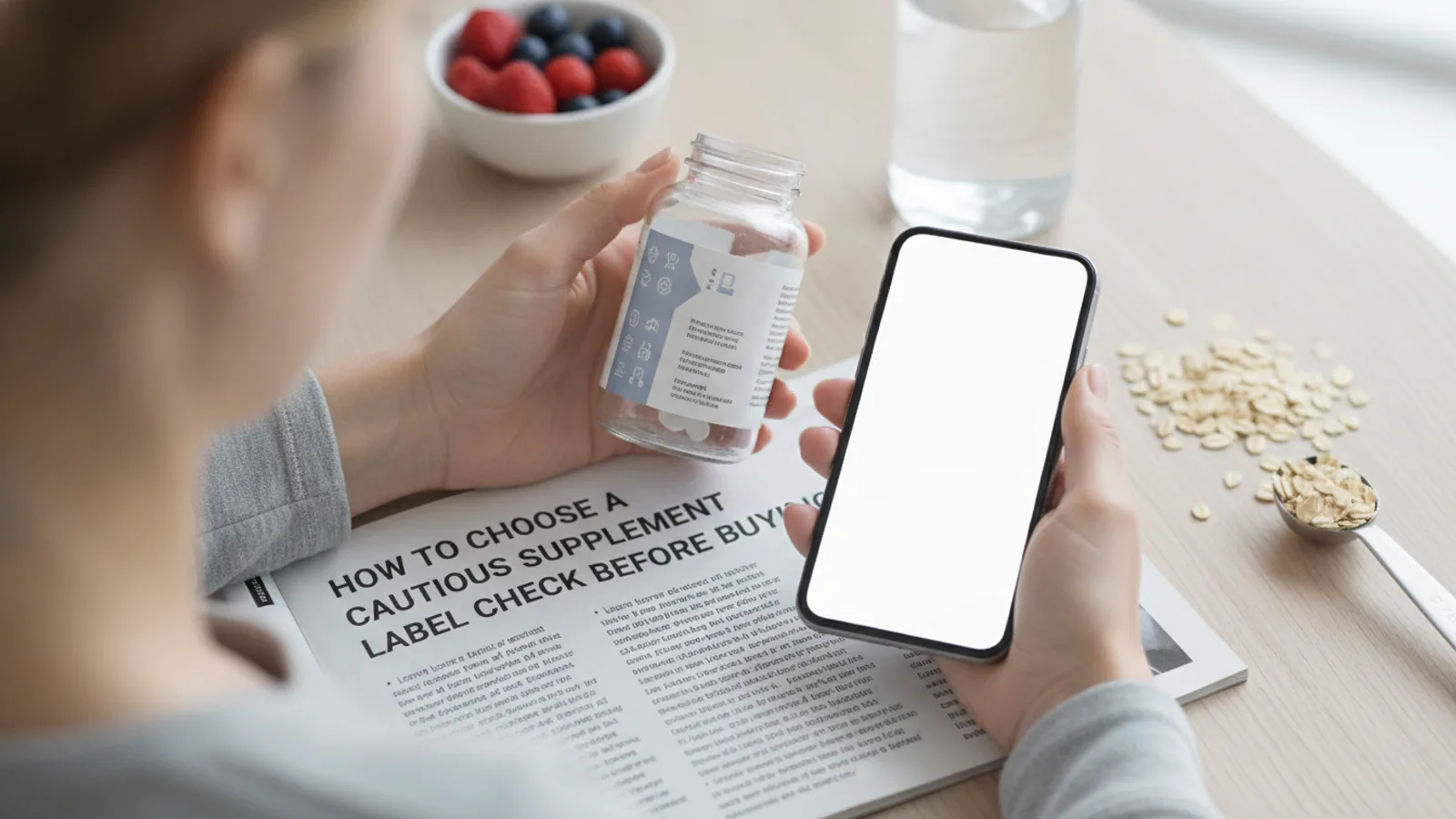
Comparing Wellness Products Without Medical Claims Checklist For First Time Readers
A practical step-by-step guide to comparing wellness products without medical claims checklist for first-time readers, including preparation, instructions, common issues, tips, and next steps.
Comparing Wellness Products Without Medical Claims Checklist For First Time Readers
This guide helps first-time readers compare wellness products — like supplements, essential oils, or fitness gadgets — without getting lost in health claims or marketing language. You'll learn to separate solid, product-level facts from vague promises by building a personal comparison checklist. Using a calm, practical method, you'll evaluate evidence, read labels with fresh eyes, question ingredients, and decide what fits your routine and budget. The steps walk you through gathering information, spotting red flags, and making a simple side-by-side chart. Common issues like confusing terminology or missing dosage info are covered, along with advanced tips for deeper research. By the end, you'll have a reusable checklist that keeps your choices grounded in observable details rather than hype.
Fast Answer
- Start by listing the specific wellness benefit you want — for example, better sleep, joint comfort, or daily energy — and write down what you'll feel or notice if that benefit truly happens.
- For each product, look for measurable details: ingredient amounts, dosage, form, how to use it, and any tests done on that exact product. Ignore vague words like 'supports' or 'promotes' until you find concrete data.
Before You Start
- Define your wellness goal in one sentence: what physical or mental change are you hoping for? This gives you a filter for every product you compare.
- Gather a list of 3 to 5 products you're curious about. Include the full product name and what the label promises — don't edit or summarize yet.
- Find the original product labels or official pages. Many retailers rewrite descriptions, so you need the source text to check doses, ingredients, and instructions.
- Keep a simple comparison chart ready: columns for product name, active ingredients, amounts, form, directions, price per use, and any supporting evidence. You'll fill it in during the steps.
Step-by-Step Instructions
Define Your Measurable Wellness Goal
Before you look at any product, write down your goal in a way you can actually observe. For example, instead of 'improve sleep,' say 'fall asleep within 20 minutes of lying down and wake up no more than once a night for two weeks.' This kind of specific outcome gives you a baseline to compare against. Without a clear goal, you'll be swayed by marketing phrases like 'supports restful sleep' or 'promotes calm.' Every product you consider should pass a simple test: does it have details that connect to your measurable goal? If a product only says general words like 'wellness' without linking them to a concrete result, that's a red flag. By defining your goal first, you create a ruler to measure any future claim. You also avoid wasting money on products that address something you don't actually need. Write your goal on a card and keep it in front of you while researching.
Collect Product Labels and Official Information
Go to each product's official label or its manufacturer's webpage and copy down everything that appears in the fine print. This includes the supplement facts panel or ingredient list, serving size, amount per serving, directions for use, and any warnings. Do not rely on a store's summary because those often omit critical details like whether a product contains allergens or what form an ingredient is in (e.g., vitamin D3 vs. D2). Look for the manufacturer's name and contact information. For a wellness device, find the official instruction manual or spec sheet. For an essential oil, the label should list the botanical name and the part of the plant used. This step builds a fact base that you'll use in the next steps. It also helps you compare similar products because you'll see differences in dosage, inactive ingredients, and usage instructions that might affect safety or comfort.
Spot and Separate Hype from Facts
Now, read each product's marketing language and underline every word or phrase that sounds like a promise, such as 'supports,' 'boosts,' 'helps,' 'promotes,' 'optimizes,' or 'strengthens.' These words are often used without a definition of what they mean in a measurable way. Next to that underlining, write the specific ingredient or mechanism that could plausibly lead to that effect — but only if that ingredient is listed in the facts panel. For example, if a sleep supplement says 'promotes relaxation,' check if it contains magnesium or L-theanine and at what dose. If the dose is not listed, that's a gap. Also watch for any clinical study mention: does it cite a specific study on that exact product, or does it use vague terms like 'clinically studied'? A product that says 'research shows' without giving you a source or a summary of the research is not giving you enough to judge. This step builds your critical eye and prepares you for the next step where you compare evidence.
Research the Specific Ingredients or Features Yourself
Use your list of ingredients or device features, and look up each one in a reliable source like a government health website, a university library guide, or a peer-reviewed review article. You don't need a medical degree — just search for the ingredient name plus 'research' or 'review' and read the summary. For each ingredient, find out: what evidence exists about its effect? At what dose was it studied? What are the common side effects? For a wellness gadget, look for device specifications like sensor type or declared accuracy, but note that a company's self-reported specs are not independent proof. Also search for what other people have observed, but prioritize sources with methods you can understand. Your goal is to find at least one piece of evidence that either supports the ingredient's use for your specific goal or disproves it. This research step is the heart of comparing because it turns marketing phrases into testable knowledge.
Complete Your Side-by-Side Comparison Chart
Now fill in your comparison chart completely. List each product in a row. Under each column, enter the exact details you found: the active ingredients and amounts, the form (tablet, powder, tincture), the serving size, and the directions. Add a column for 'evidence level' where you rate each product from 'none found' to 'some supporting research' to 'well-supported.' Also note the price per serving — calculate this by dividing the total price by the number of servings, not the full bottle price. Finally, add a 'red flags' column: anything that made you pause, such as proprietary blends (where the label doesn't show amounts), missing contact info, or claims that seem too good. Be honest with yourself. This chart is your personal comparison tool, and it will let you see at a glance which product has the most evidence, the clearest dosing, and the fewest red flags. That's the product you can feel most confident about trying, if you decide to try any at all.
Make a Decision and Set Up Your Own Test
Using your completed chart, choose the product that scores best on evidence, ingredient amounts, and red-flag count. If two products tie, pick the one with the simpler ingredient list and the most transparent labeling. Once you've chosen, set up your own single-variable test: before you start, measure your baseline (for sleep, track how long it takes to fall asleep for three nights). Then use the product exactly as directed for a fixed period, like two weeks, while keeping your routine otherwise the same. In a journal, record your symptom or outcome each day. After the test, compare your average results to your baseline. If there's a clear improvement that you can attribute to the product, it might be worth continuing. If not, stop and try another product from your list — or decide that no product is needed. This step turns comparison into a personal experiment, which is more reliable than trusting a claim.
Quick Reference
| Situation | Action | Why it helps |
|---|---|---|
| A product label says 'supports healthy joints' without showing any ingredient amounts on the front. | Compare that label with the Supplement Facts panel: if the amounts aren't listed there either, search the manufacturer's website for a full ingredients disclosure. If you can't find it, call or email the company and ask for the exact amount per serving. | If the manufacturer won't reveal amounts, you can't evaluate whether the dose is enough to have an effect, and you also can't compare it to other products in a meaningful way. |
| You see a promotion for a wellness drink that says 'clinically shown' but doesn't mention a specific study or a summary of the results. | Ask for the exact publication or study reference. If they don't provide it, search the product name plus 'clinical study' and look for a peer-reviewed journal with a method you can read. If you find nothing, mark it as 'no verified evidence' in your chart. | The phrase 'clinically shown' is often used loosely; without a source, you have no way to check who did the study, how many people were involved, or whether the results were meaningful. |
| Two similar products have the same ingredient and amount, but one costs much more per serving because it's 'organic' or 'from a special source.' | Check the label for the exact source or certification mark, such as 'USDA Organic' or 'Non-GMO Project Verified.' Then look up what that certification actually requires and decide if that extra factor matters to you. In your chart, add a column for 'certification' and compare the price per serving of the identical ingredient amount. | A higher price might be justified if you specifically value a certification, but it's not proof of better effect. You need to compare the actual ingredient and dose, not just the price. |
Common Issues
- You can't find the ingredient amounts because the product uses a 'proprietary blend.': Look up the official definition of a proprietary blend on a government regulatory page, then note that the total weight of the blend is given but individual amounts are not. On your chart, write 'unknown amounts' for each ingredient. If you still want to compare, search each ingredient's typical dose in published research and see if the blend's total weight is enough to contain an effective amount — but remember, you're guessing. For a safer comparison, choose a product that lists each ingredient and its dose.
- The product's website lists a study, but the study isn't about that exact product.: Check the study details: what product or substance was tested? If it tested an ingredient that happens to be in the product, that's weaker evidence than a product-specific study. Write down the study's participant count and duration, and compare it to what you want. If the study used a different form or a much higher dose, that's a red flag. Update your chart to reflect that the evidence is ingredient-related, not product-related.
- You're confused by terms like 'standardized extract' or 'bioavailable form.': Use a reliable health dictionary or trusted website to look up these terms. For example, a standardized extract means the manufacturer guarantees a certain amount of an active compound. A bioavailable form is one the body can absorb easily. After you understand the term, check the label to see if the product specifies the standard or the form. If it doesn't, mark it as 'unclear' in your chart. If another product explains it clearly, that product is easier to evaluate.
Advanced Tips
- Look for third-party certifications that focus on quality, like NSF International or USP verification. These certifications mean an independent organization checked the product for consistency and purity, but they don't prove effectiveness.
- For a deeper dive, search the ingredient name plus 'systematic review' or 'meta-analysis' in a free research database like PubMed. These papers combine many studies and give you a broader view of what the evidence shows overall.
- Track your own results over a longer period, like six weeks, because some wellness effects take time to appear. Keep a simple log with your goal, daily notes, and a rating scale from 1 to 10, so you can spot subtle changes.
Final Checklist
- I wrote down a specific, observable wellness goal so I can tell if a product works for me.
- I collected the full label and official product information, including ingredient amounts and directions, for every product I compare.
- I identified at least one red flag or unclear area in any product's labeling or marketing and looked for verification in a neutral source.
- I filled out my comparison chart completely, including price per serving, evidence level, and red flags, and I used it to make my decision.
FAQ
Do I need to consult a doctor before trying a wellness product?
Yes, it's a good idea, especially if you have an existing health condition, take any prescription medication, are pregnant, or are nursing. A healthcare provider can review the product's ingredients and advise on potential interactions or safety issues. You can also ask your pharmacist. Even if a product is natural, it can still affect your body, and your provider knows your personal health history.
Should I always choose the product with the most research evidence?
Not necessarily. The evidence must also match your specific goal and the product's exact formulation. For example, a product might have an ingredient that has research support, but the product's dose might be too low to be effective, or it might be in a form your body doesn't absorb well. Also, evidence quality matters: a few small studies are weaker than a large well-designed study. Use your comparison chart to weigh evidence, dosage, and red flags together.
What if I compare products and find that none of them have strong evidence?
That's a common situation. If no product meets your criteria of solid evidence and clear labeling, you have three options: wait for more research, choose the product with the least concerning red flags and try it carefully, or decide that a wellness product isn't necessary for your goal. Sometimes, lifestyle changes like improved sleep habits or a balanced diet achieve a goal without any supplement or gadget. Your comparison chart is still useful because it saved you from spending money on something with no support.